Pages

Showing posts with label horse training. Show all posts

Tuesday, May 17, 2011

Horse Training: Do You Know Where Your Horse's Feet Are?

Do you want to teach your horse basic maneuvers such as picking up the correct lead, side passing, or rolling the hind? Would you like to know what diagonal or lead you are on without having to look down? Or do you want to do more complicated moves with your horse like spins, haunches-in, or sliding stops?

To teach your horse all of these moves requires one basic thing: knowing where your horse's feet are at any given time. To know where your horse's feet are without actually looking down all the time, you need to develop "feel," meaning that you need to be able to feel the placement of your horse's feet and body.

Developing "Feel" in Horse Training
If you have ever tried to develop the ability to know how your horse is positioned without looking, then you might know that the process can be frustrating, if not downright annoying. After all, how are you supposed to be able to "feel" your horse's feet, which are very far away from you?

Luckily you can start with baby steps and work your way up. There are two exercises that I found to be very useful when I first started trying to sense the placement of my horse's feet. Both are done at the trot, which seems to be the easiest gait for me to sense what is happening.

1. Sitting Trot
At the sitting trot you can develop feel by noticing how your hips and seat bones shift from side to side and up-and-down as the horse stretches forward with one diagonal pair of legs, and then with the other pair. You will notice that on any given stride one of your hips will move down and back while the other hip moves forward and up. Begin to correlate the movement of your horse's front feet with a certain position of your hips. For instance, you might say, "Ah, when my hips are positioned like this, my horse's right front leg is forward and the left front leg is back." Making this connection between your visual sensing and your body's position is the first step in developing 'feel.'

You can also do a more advanced version of this execise. As you are sitting the trot, sense which front hoof is moving forward and which one is back without looking down. You'll find, in time, that you will be able to 'see' the movement and position of your horse's front legs in your mind's eye. Look down from time to time to check whether your senses are correct. Don't worry if you find that you are often wrong. Stay with the exercise until you develop the right feel. Trotting down a long straight trail is perfect for practicing this exercise. It took me many rides down the ditch bank before I developed an accurate feel, but the time spent was well worth it.

2. Posting Trot
You can also practice developing feel at the posting trot, and this is an especially useful option if you find the sitting trot difficult. The posting trot is where you rise up out of the saddle and put your weight in the stirrups every other stride. As you trot down a long trail, pick up a random diagonal (or rise up out of the saddle on a random stride). Notice the sensations in your hips and seat bones as you post in this random diagonal. Then look down and check your diagonal (if you don't know about diagonals, just notice which front leg is forward as you rise up out of the saddle). Make the association between the way your body feels and the diagonal. Next, stay up out of the saddle for a random number of strides, and then pick up the posting trot again. Sense whether the sensations are the same or different than last time. As with the sitting trot you will feel one hip sitting lower and farther back in the saddle each time you sit. Keep working with the random diagonals until you develop a better feel.

To do a more advanced form of this exercise, stand up in your stirrups (a position called two point) as you trot. Sense the forward and backward movement of your horse's front legs. Try to 'see' them in your mind's eye. Look down periodically to check if you are correct. Don't be discouraged when you are incorrect, just keep practicing. Once you master these exercises, you will have a solid foundation from which to further develop your feel for more advanced manuevers.

What About You?
Do you have any great exercises for developing 'feel' from the saddle? If so, please write a comment so that we can all benefit! Thanks for stopping by!

If you enjoyed this post, please consider leaving a comment or subscribing to the feed to have future articles delivered to your feed reader. Also, check out my ebook for wacky horses and humans, or holler at me if you want to know how I fund my horse addiction ... and you can, too!

Thursday, April 22, 2010

Increasing Horse Try: "Hold My Face, Hold My Hand!"

Horse try--or the willingness of your horse to perform for you--varies widely according to the horse you're riding and the task at hand. Believe me, I know! I have 3 mustangs, a QH, and a warmblood. I jump, rope, rein, trail ride, and start colts.

Mixing and matching these horses to the right career to maximize "horse try" is a little complicated at times!

But I have figured out some stuff along the way ...

Increasing Horse Try by Holding a Horse's Face

This is a horse training technique I have come to over time, by riding a bunch of horses who range from pushy types to insecure types. I've discovered that many horses feel more secure if I can establish light contact with their mouth, and then just hold that contact through my ride ... or at least through the scary part of the ride.

Having said that, the words "hold the horse's" face can mean a lot of different things to a lot of different people, so let me clarify. Usually, when I teach a horse to allow contact with his mouth, I'm riding him in a simple snaffle bit-no shanks, no fancy stuff.

The snaffle allows direct contact without exerting poll pressure. This is important because a lot of horses will "disappear" by tucking their head behind the vertical, thus disallowing the contact. A snaffle, on the other hand, exerts pressure on the bars and tongue, and does not encourage this disappearing act.

To teach a horse to accept contact, I generally simply walk a circle. At first, I take up no contact, and just allow the horse to put his head and neck wherever he wants. Gradually, I increase my contact with the horse's mouth by taking up the slack in the reins. I encourage him to reach down and out as he walks, alternating between medium contact, when I'm asking for more stretch, and light contact when he is stretching. I am using my legs to squeeze him forward into the contact.

Once a horse accepts contact and learns to stretch down and out, his seventh cervical vertebrae, which I've written about quite a bit, is positioned for calmness and relaxation. In turn, the feel of "contact" then becomes a reassuring thing to the horse. The next time the horse is in a dicey situation, then I take up a little contact, and all is well again. I have increased the level of "horse try" even situations are scary.

Three Examples of Increased Horse Try
Here are some cases in point to show you what I mean.

Example One of Horse Try - Neighbor's Horse
I was recently swapped horses with my neighbor on a trail ride. My neighbor's mare is all about speed, didn't know how to walk, and had a Gumby-neck. She could also put herself into a sweat just walking. She's always amped. Her head and neck constantly "disappeared" when she tucked her chin to her chest, and she had no idea how to move away from my leg. Any leg pressure always meant "go faster!"

During the trail ride all I did was pick up and put down contact, sit heavy in the saddle, and constantly encourage her to walk instead of jig. The more I did this, the more the mare stretched out and "looked" for my hands and contact. After a while, we were able to walk peacefully down the trail with me "holding her face" with about 2 ounces of pressure. She LOVED light contact and would walk with a long stretchy neck. I felt like I was holding a child's hand for reassurance, only I was holding the mare's face instead! The mare developed a lot of horse try with this technique.

Example Two of Horse Try - Walker
The second example is Walker, my rope horse. We were at Mary and Dusty's working a bunch of new cattle, and teaching the cattle to run straight out of the chute and down to the stripping chute. We "scored" our horses, which means we made them stay in the boxes until we asked them to leave. We would watch 5 or 6 steers leave the chute before ambling out after them at a walk.

Walker got so excited by the steers he started rearing because I would not let him chase the steers right out of the chute. He's got a lot of cow in his breeding so I'm not surprised. I thought about giving him a couple of doses of Eleviv to help him handle the stress, but decided that he wasn't actually stressed, just excited!

When I finally got him settled again, I tried holding his face lightly while I talked to him. That worked great. He dropped his head low and held it there. He knew, from our previous work, that when I had contact with his face, he was secure. He then waited patiently until I told him he could chase the steers by releasing my contact. This is a case where Walker had too much "horse try" and I simply had to redirect it.

Example Three of Horse Try - Reyacita
Reyacita has also been roping. She's got plenty of horse try, but often feels stressed when new elements are introduced into our training regimen. Being a Metal horse personality type, fond of routine, this isn't surprising. The steers, the chute, and the "scoring" were all new, so she went into her stress response of having COPD and heaves.

I haven't spent as much time with Reyacita in training as I have with Walker, so I did two things: I gave her some Eleviv, which always calms her COPD symptoms right away, and then I backed her into the box and took up some contact. Like Walker, Reyacita responded my breathing deeply, relaxing her neck, and simply waiting for me. In this relaxed position, she was able to take in the new elements in the environment without stressing out.

At the End of the Day ...
My conclusions are that horses, like humans, feel better when they know their boundaries. Holding a horse's face with light contact is one way to give a horse a feeling of a boundary. The contact is so light that it is in no way a punishment or correction, but merely a statement of, "Here I am. I've got you. Don't worry." It's a boundary they can feel, lean on if they must, and definitely trust.

Because of what I have learned about the value of holding a horse's face, and how it helps a horse try harder, I now would far rather ride a horse who takes up too much contact than a horse who won't accept contact. And for the horses who won't accept contact, that's all I work on until they will accept contact.

Pretty cool and simple, really... don't you think?

If you enjoyed this post, please consider leaving a comment or subscribing to the feed to have future articles delivered to your feed reader. Also, check out my ebook for wacky horses and humans, or holler at me if you want to know how I fund my horse addiction ... and you can, too!

Photo credit: http://www.flickr.com/photos/rayand/4183524983/

Tuesday, April 13, 2010

Horse Training: What Your Horse's Rear End Can Tell You about His Head

A while back I wrote a blog post about how your horse's tail can tell tales. In short, the flexibility of your horse's tail tells you something about the flexibility of his personality ... or of his ability to transition easily from one activity or career to another.

Now I have a follow up chapter to that story. As I mentioned in that previous post, Walker's tail was unbending, and he very much disliked me "playing" with it. It's now a few months later, life has changed for Walker, he has a new career ... and his tail reflects a fundamental change in his personality.

What's Been Happening with Walker?
Since my first post about the tails a few months ago, Walker has continued to grow and learn in his new career as a roping horse. You might recall that when we first started in roping training, Walker was terrified of the lariat because he had been roped as a 3-year-old, much to his terror.

Several horse training sessions with very slow rope work, along with very regular doses of the herbal supplement Eleviv, have changed Walker. I would give Walker 2 capsules of Eleviv daily, and then 2-4 capsules of Eleviv before we went for roping practice. It worked wonders. He went from bolting at top speed to get away from the rope to simply accepting the rope.

He has also become a thinking horse. Being a heeling horse, it's important for Walker to stop in his tracks the moment he sees me throw my rope. Otherwise, the chances of him getting a front leg caught in the loop are high. Earlier in his roping training, we had not been as careful about stopping as soon as I threw the rope. Sure enough, I caught his front foot with my loop.

What was really cool is that instead of bolting, Walker just stopped. He froze, and waited for Dusty, our instructor, to release him from the loop. That's the reaction of a thinking horse who is operating from his healthy parasympathetic nervous system, not the reactive bolt of a horse coming from his "fight or flight" sympathetic nervous system. I was impressed. What was even cooler was that thereafter, Walker always stopped when he saw the lariat leave my hand. He "learned" rather than "reacted."

What's Up with Walker's Tail
A few days ago, I took Walker to another roping clinic. This was the first time we worked outdoors. We worked on standing quietly in the boxes while watching the chute open and close. The chute is pneumatic so it makes a hissing sound every time it opens or closes. It also clangs like a son of a gun! A lot of horses at the clinic hated the thing on sight!

Since this scenario contained a ton of new horse training elements (including steers at the far end of the arena), I wondered how Walker would be. I tried to give him his Eleviv before we left, but he refused to take it. When I finally forced it into his mouth, he spit and spit and spit. I trust his instincts so I simply loaded him into the trailer and away we went.

I was concerned that with so many new elements in the outdoor arena and no Eleviv, Walker would be a basket case. He wasn't. In fact, it was just the opposite. He was the star of the clinic. He was one of only two horses who would stand quietly and correctly in the box, then move quietly out of the box to chase the Robosteer, and get into position for me to toss the rope. This was the case even when the wind started kicking at gale force winds.

I was amazed ... practically agog with surprise. I had to find out what was going on.

As soon as I had him unloaded at home, I tied him to the trailer and messed with his tail. To my surprise, his previously inflexible "stiff as a board tail" was now soft and flexible. He didn't mind me bending it, swiveling it, or gently twisting it.

I thought maybe it was a fluke so I tried it again the next day. Same deal. Soft tail. So now, I'm beginning to think that with the help of our "going slow is faster" horse training methods, along with the months of Eleviv, Walker has fundamentally changed in character. No longer is he a reactive and fearful horse. He is now a thinking, accepting, and trusting horse.

He was able to accept all the elements of the outdoor arena with ease and grace, and he NEVER lost his cool. How cool is that?

So now I believe that I can "read" more about what's going in my horse's brain by "feeling" the flexibility of his tail. His tail does tell me tales! I love it. Now, of course, I have to go play with all the horses in the pasture to see if this is true, but I am like a bloodhound who is onto a scent ... I won't let go of this topic until I verify my hypothesis.

What about y'all? Have you played with this? Tried it? Gotten any results other than a pile of poop at your feet?

If you enjoyed this post, please consider leaving a comment or subscribing to the feed to have future articles delivered to your feed reader. Also, check out my ebook for wacky horses and humans, or holler at me if you want to know how I fund my horse addiction ... and you can, too!

Tuesday, March 30, 2010

Horse Training: How Well Does Your Horse Try for You? Getting More Try

I hear horse trainers talk all the time about the level of a horse's "try." Most trainers like horses with a lot of try. In fact, one trainer I know will choose a horse with a poor comformation but a lot of try over a horse with super talent and very little try.

A lot of "horse try" can overcome many obstacles ... including lack of innate talent or poor comformation.

This is all well and good for the horse with a lot of try, but what about the horse who doesn't try? How do you get more try out of that horse?

Horse Try: Finding the Right "Hot Button" or Motivation
For the equine with little or no "horse try," the horse owner's job is to figure out why the horse has no try. The reasons could include:
  • fear of punishment or pain
  • fear of new things or concepts
  • boredom
  • dislike of his current career
  • physical inability to do his job
  • sheer laziness
  • a competitive streak
  • lack of understanding of the task
Lack of Horse Try: Some Examples
I have three horses in roping training now (I'm learning with Mary Duke and Dusty Healey of Stirrup Cup Farm), and each horse has experienced at least one bump in the road ... a place where he or she had no "try." The interesting thing was that, knowing each horse personality type, I was able to figure out the reason behind the lack of try, and solve the problem. (Learn more about horse personality types here and test your horse's personality type here.)

Lack of Horse Try Because of Fear
Walker, the gelding I've written so much about (and pictured above), lacked try because he had been roped as youngster, and was traumatized by the lariat. As a Shao Yin horse personality type, his main goal is to please his human, but his fear kept him from doing so. He would try and try to bear the rope exercises until he just couldn't. Then he would bolt at Mach-1.

Solution: Because Walker was still suffering from the trauma of being roped earlier, that meant he was stuck in his "fight or flight" sympathetic nervous system and literally could not think rationally. My solution was to start feeding him Eleviv, an herbal supplement that shifts horses (and humans) back into the normal parasympathetic nervous system. From this nervous system, horses can think rather than react. Another herbal supplement that works well is RelaxBlend from Equilite. Feeding probiotics can also help, since probiotics like acidophilus and bifidus produce B-vitamins, which can keep a horse calm.

Now Walker gets 2 capsules of Eleviv before roping practice, and has all the horse try in the world. He is, in fact, one of the star students of our little beginning roping clinic.

Lack of Horse Try Because of Misunderstanding
The second horse I introduced to roping training was Reyacita, a five-year-old mustang mare. Being a Metal horse personality type, Reyacita's primary goal in life is to understand her job clearly, and do it well. Once she understands her job, she will do it unfailingly. If her job description changes, she will demonstrate a lack of try.

When I first introduced Reyacita to roping, she lacked try because until then, her job had been "trail horse." Roping was not part of her resume.

Solution: To integrate roping into Reyacita's job description without having her buck me off, I started out slow. By introducing roping to her in several logical "chunks," she was able to understand her new job relatively quickly. For instance, we took it in these small steps:
  • practice the rope exercises (created by Stirrup Cup Farm) at home
  • introduce Reyacita to the Robosteer
  • have her follow the Robosteer in the correct position, rewarding her each time she does
  • practice throwing the lariat with the Robosteer at a standstill
  • practice throwing the lariat at the moving Robosteer
These small steps, introduced over several sessions, allowed Reyacita to add roping to her job description. She also demonstrated much more horse try than she had before. I also gave her Eleviv before each session because Metal horses are among the slowest learners of all the horse personality types (but once they learning something, they never forget!). Eleviv helps Metal horses learn new tasks more quickly while being less resistant.

Lack of Horse Try Because of Boredom
The final horse I put into roping training was my big mustang jumper mare, Valentine. Valentine is the prototypical Wood horse personality type: super talented, super competitive, and easily bored. Valentine has the talent to jump around super big jumper courses ... but getting her to do it consistently is another story. Jumping bored her to tears. After 2 seasons in the jumper ring, I was exhausted by Valentine's lack of horse try ... and I had the bruises to show for it.

Solution: Since Valentine does enjoy chasing things, like cows, I decided to try her at roping. She loves to do ranch sorting and team penning, but once she cuts her cow out of the herd, she just likes to run, whether she keeps the cow in control or not. Thus, I don't take her penning much.

But roping doesn't require rolling back on the fence line and going back after the cow if you lose it, so I thought roping might just be the perfect niche for her. She has never been afraid of the lariat, having pulled steers, posts, and all manner of other items with the lariat, but when I started working with the lariat at Stirrup Cup Farm, Valentine was a mess! Talk about lack of horse try! She spun in circles, she snorted, she acted silly. She wasn't afraid, just bored and acting out.

Dusty came up with the brilliant idea of moving the Robosteer, which she liked to follow, while I swung my rope. As soon as Valentine saw the Robosteer move, her competitive instinct kicked in. She flattened her ears and went after the steer like crazy. The lariat became of no importance. Suddenly, we had horse try. I was able to easily position her in the heeling position, and rope both hind feet. Presto! Horse try, at last.

What Will Increase Your Horse's Level of Try?
Every horse has plenty of "try" if you find the right motivation to awaken the horse's desire to try. The lazy horse with a sweet tooth may have more try when offered treats. The competitive horse, like Valentine, may need to redirect her competitive nature toward the steer instead of toward her rider. The fearful horse may need plenty of reassurance and slow introductions to new things. He may also need herbs like Eleviv or RelaxBlend to help him deal with stress.

Your horse's personality type often says a lot about why he won't try. Here's a short rundown of the types and the reasons they won't try.

Fire Horse: lack of attention from their human, knowing they can't do the job for physical reasons

Wood Horse: competes against the rider or trainer rather than against the clock or the steer

Earth Horse: too lazy; needs to be motivated by food treats or rewarded for effort with short workouts

Water Horse: fearful; needs slow introductions to new lessons in a safe environment, and lots of praise

Metal Horse: needs consistency and routine in training until he knows his job; if his job description changes, the change needs to be introduced slowly, in small chunks

I hope that helps you understand why the horse try may be lacking in your equine friend. To type your horse, visit the Horse Harmony Test website. To learn more about each type, read more or buy the book on the Horse Harmony website.

If you enjoyed this post, please consider leaving a comment or subscribing to the feed to have future articles delivered to your feed reader. Also, check out my ebook for wacky horses and humans, or holler at me if you want to know how I fund my horse addiction ... and you can, too!

Photo credit: Mary Duke of Stirrup Cup Farm

Tuesday, March 16, 2010

Horse Training: Taking Advantage of the Horse Herd Instinct

Horse herd instinct works to your disadvantage when you are working with a herd-bound horse, but you can definitely use it to your advantage in horse training when introducing a new and possibly scary concept.

Call it group think or the hundredth monkey principle ... or possibly just the tenth horse principle.

Whatever you call it, the horse herd instinct can help you train a horse faster than in a solo environment. With herd instinct always at play in the background, a "newbie" horse can quickly learn something new by watching one or more experienced horses do the very thing you want to teach.

The Roping Clinic: An Example of "Group Think"
A classic example of horse "group think" was a session of a roping clinic, a while back, with my sometimes "freaky" horse, Walker. Just for a little background, this was the first session of the clinic where horses were involved. The first two sessions of this clinic focused on teaching us wannabe ropers to swing the rope ... and avoid hitting unexpected objects and people.

During this third session, the horses were introduced to the Robo-Steer, a mechanical steer on wheels guided by remote control. The Robo-Steer is covered in cowhide and looks kind of like a steer, but makes funny noises when moving ... and moves its hind legs back and forth, up and down as it moves. It also creaks. A potentially scary object for any horse.

To help ease the horses into working with the Robo-Steer, Mary and Dusty of Stirrup Cup Farm had invited Walker and I to come up and work with the Robo-Steer prior to this session of the clinic. Walker and I played with the Robo-Steer a couple of times before the clinic, until Walker was familiar with the machine and actually liked chasing it!

During the clinic, with all horses present, Mary and Dusty had me and Walker follow the steer along with my neighbor (Katee) on her mare, who had never seen such a machine. All the other horses watched. At first, Katee's mare snorted and would not get close to the Robo-Steer. However, after seeing Walker walk calmly beside the steer and touch it with his nose, she gradually got into the game.

As soon as she touched the machine with her nose, Dusty would stop it. This became a game of "cat and mouse," and the mare became fascinated with the idea that SHE could control the machine just by touching it. That got her interested in chasing the Robo-Steer, fast!

Using Herd Instinct: The Rest of the Group Joins In
Once Katee and I had followed the steer for three circuits of the arena, the rest of the horses "ganged up" on the machine in pairs. It was amazing to see how each pair of horses learned to accept the Robo-Steer. Each pair showed progressively less fear than the pair before. In other words, by seeing other pairs of horses chase the machine and return to the group unharmed, the remaining horses learned to be unafraid. What was interesting was that the horses that were watching actually licked and chewed as they watched ... a sure sign of learning and acceptance in "horse speak."

The "group think" idea worked great until the last pair of horses. One of these horses was a spooky young colt, and despite the fact that his partner horse was fine, he himself refused to get close to the machine. So Walker and I, along with another horse and rider, joined the pair up by the Robo-Steer.

Now we had a "herd" of four horses ganging up on the machine, three of whom were unafraid of the machine. With the addition of two new horses to the "herd," the spooky colt quickly learned to touch the steer. In fact, it took only two circuits of the arena for this horse, who was truly scared, to accept the machine. Once the colt lost his fear, the two of us who had joined the group peeled off and returned to the end of the arena. Then the original pair of horses made a couple more loops around the arena, touching and stopping the machine easily.

It was amazing! Even though we needed to introduce seven new horses to the Robo-Steer, the whole process took less than an hour. And each new pair that approached the machine, with the exception of the scared colt, was progressively less and less fearful.

Horse Training and Putting the Herd Instinct to Use
This example of "group think" probably explains why many horses do so well learning at clinics, in a group or herd environment. The herd instinct allows them to learn through the experiences of other horses at the clinic. It works the same for humans, too. Have you ever been to a workshop and literally leapt up a learning curve, almost effortlessly? That's because you are tapping into the pool of group energy.

The good news is that you don't necessarily have to have an entire "herd" to use the herd instinct for your horse training program. This herd instinct phenomenon works well with just two or three horses.

For instance, Mary and Dusty often put young colts in their round pen, which is right next to the arena, while they rope the mechanical steer with more experienced horses. The colts get the watch the older horses schooling, and learn that neither the steer nor the rope are to be feared. When these colts go into training they are tractable and very easy to teach, having already "previewed" the lessons many times.

In fact, this herd instinct is so powerful that they can literally rope off colt who has never been roped off of, almost from day one. Not only that, but the colts go into training already tuned into the idea that it's fun to chase the mechanical steer. Now that's pretty cool! It saves you, the cowboy or cowgirl, a lot of time and effort, not to mention decreasing your chances of getting bucked off or run away with.

Using Group Think with Traumatized Horses
The herd instinct is a particularly powerful tool for horse training for traumatized horses. Walker is the perfect example. Having been repeatedly roped as an almost-feral three-year-old, Walker associated the rope with all things bad, including castration, vaccinations, and intensive training.

Two things helped Walker get over his fear of ropes:

1. Standing in the arena (with me on the ground or in the saddle) watching Dusty rope the Robo-Steer. This taught him that we were never going to rope him, only the mechanical steer. Watching Dusty rope over and over, edging closer to him all the time, Walker finally realized that no matter how close the rope came to him, the loop was never going to end up around his neck.

2. Getting 2 capsules of Eleviv herbal supplement before starting the lesson. Since Walker would immediately go into his "fight or flight" sympathetic nervous system whenever he saw the rope, the Eleviv was useful to keep him relaxed in his normal parasympathetic nervous system. When operating from this nervous system, he was able to be receptive to the lesson and watch Dusty rope without fear. Without the Eleviv, I wasn't able to get Walker into the arena when Dusty was roping. With his herbal "helper," Walker was willing to try new things. It helped him think rather than react.

So there you have it. The 100th monkey principle works great on horses because they already operate from their herd instinct. Throw in some Eleviv for horses who have been traumatized, and you now have two new tools for your horse training tool box.

Awesome! I love anything that saves me from getting tossed in the dirt!

If you enjoyed this post, please consider leaving a comment or subscribing to the feed to have future articles delivered to your feed reader. Also, check out my ebook for wacky horses and humans, or holler at me if you want to know how I fund my horse addiction ... and you can, too!

Photo credit: Mary Duke of Stirrup Cup Farm

Thursday, February 25, 2010

Horse Training: Creating the Thinking Horse

Have you ever worked with a horse who "just wants to get it over with"? In other words, as you are working with the horse on a particular exercise, he rushes through it quickly so he can be done and be turned back out to pasture. Sound familiar?

Those are the actions of a reactive horse, not a thinking horse. Yikes!

Those kinds of horses scare me because I know that if I ever get in a jam with that kind of horse, he's going straight into his "fight or flight" reflex, and he's not going to listen to a single signal I'm giving him. He's going to "rush" and "react" until he feels safe again. Reactive horses rush through things, which can be dangerous.

The Illogical Logic of the Reactive Horse
During horse training, reactive horses don't seem to operate on any sort of logical premise. These horses just rush through stuff. They run, they buck, they rear ... they basically cause chaos and damage because they don't feel safe. They seem quite crazy, but in actuality they do operate from a real logic chain, albeit one that doesn't make a whole lot of sense to us. Reactive horses seek one thing:

Safety.

When in "fight or flight" mode, reactive horses rush around and use whatever means they can to get to safety. Here are two examples.

Example 1: George
First, there's George. George was a 16 hand quarter horse I bought from a lady who was quite vague about whether he was actually saddle broke. Her words were something like, "Well, we've hopped on a few times." Hmmm, not at all reassuring. Therefore I treated George as a completely unbroke colt and started from the ground up. Training progressed quickly and well until we got to the lope. Then all hell broke loose. Talk about the "reactive horse rush"!

George would bolt anytime we stepped into the lope. He'd make one good circle and then head off in a straight line. In fact, the lope scared him so much he'd run straight for the trailer, where I normally untacked him. His logic chain went like this: "This loping thing scares me the death so I'm going to run to where we take this saddle off so I don't have to lope. Trailer, here I come!"

Example #2: Walker
The second example involves Walker, my reiner-turned-roper. He had apparently been roped and traumatized many times as an unbroke 3-year-old, and when I started him in roping training, he lost it ... several times. His reaction was similar to George's. Like all prey animals in flight, horses rush for safety ... and Walker sure did. The groundwork with the lariat worked fine, but when I got on and started sacking him out with the lariat, he reacted.

Walker ran for safety which, in his case, meant the company of his pasture buddy Fezzywig. No amount of pulling on one or both reins had any effect. Walker had Fezzywig and safety on the brain. It wasn't until Walker saw the 5-foot solid horse panels that he slid in a 10-foot sliding stop, leaving unbelievable tracks behind him. Yowza. Not fun. Luckily, with Walker in a "sitting" position, I was able to step right out of the saddle safely. Nevertheless, Walker's little spazz-attack convinced me that transforming a reactive horse to a thinking horse was more important than ever.

Horse Training to Create the Thinking Horse
I've had a lot of different horses in my checkered horse career, all of them with different temperaments, and I've learned several ways to transform a reactive horse to a thinking horse. Some of these ways are old cowboy tools, and others are newer nutritional tools. They each have their place my horse training toolbox.

Horse Training Tip #1: Cowboy Up
This isn't always possible, depending on where you do your horse training and how much you feel you can "cowboy up," but it can work really well if you're up for it.

With George, I had fewer tools than I do today. I ended up solving his bolting problem the old-fashioned cowboy way. I took him out to an open pasture and starting loping him. When he bolted, I let him run, and then I asked him to run faster. I kept him running until he wanted to stop, and then I asked him to keep running.

I kept him at a high lope until he started to twitch his ears back and forth and even lick and chew. Amazingly, he could lick and chew even while loping really fast. These were signs that he was starting to think rather than just react. I let him stop loping after that. He did this several more times after the first incident, but then was "cured" of his bolting.

I could easily cowboy up with George because I had plenty of room for him to run with no danger of hitting any obstacles. I was also lucky that he was a runner and didn't buck, which made staying in the saddle easy when he bolted.

Horse Training Tip #2: Buddy Up
Many fearful horses learn to think instead of react by watching other more experienced horses perform a fearful activity. For instance, my neighbor and I both own several horses, and we both decided that all of our horses should learn to accept having a rope thrown from their back. Following an amazing guide written by Mary Duke and Dusty Healey of Stirrup Cup Farm, my neighbor Katee and I have been preparing our horses to accept the rope.

We noticed that whenever we worked together, one with a green horse and one with a more experienced horse, both horses remained calm. The green horse watched the more experienced horse accept the rope, and learned instantly that the rope wasn't something to be feared. This turned the green colt into a thinking horse. This has advanced our training progress by leaps and bounds. In fact, we have found that when we work our green horses independently, the progress is much slower and the chances of our horses reacting much greater.

Horse Training Tip #3: Cancel the Fight or Flight Reflex
I'm pretty much always ready to cowboy up when I'm already in the saddle and the horse underneath me bolts, but I like to avoid it when I can. To that end, I definitely "buddy up" with other horses when riding a green colt.

These days I also have another tool: an herbal supplement called Eleviv that literally has the effect of canceling out a horse's reactive response.

More scientifically, this herbal combination has the effect of switching panicked horses, who are in their "fight or flight" sympathetic nervous system, back into their more normal relaxed parasympathetic nervous system. This is important because many traumatized horses remain stuck in the panicked sympathetic nervous system after trauma, even if they seem calm on the outside.

Walker is a perfect example. He worked like a perfectly broke reining horse and it wasn't until I started trying to rope off of him that I realized that he was still traumatized about the lariat.

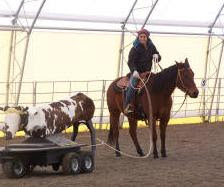
I started Walker on 2 capsules of Eleviv a day and gave him 2 extra capsules when I went to ride him. Within about 4 weeks he was calmly roping the RoboSteer with another horse (see our practice pic above). Within that 4 week period, the weather was so bad that I worked him no more than 6 sessions, 4 times at Stirrup Cup Farm and twice at home. That's pretty amazing progress for a horse who was so panicked by the lariat that he literally bolted. The Eleviv is now one of the most important tools in my horse training toolkit.

Read more about Eleviv and how it's used for horses and humans in the Natural Solutions ebook.

Horse Training for the Thinking Horse
So there you have it ... three of my favorite tools for transforming the reactive horse into to thinking horse. I have to admit, these days I do less cowboying up than I used to, but I do love to cowboy up. It's fun. But there are also less traumatic ways to train a thinking horse, and these days I tend to use those methods more. For one thing, these methods are not as hard on my body, and I definitely don't like it when horses rush through things. For another, they are a heck of a lot more convenient!

What about you? Got some great ideas for creating a thinking horse? Please leave me a comment or contact me. I'd love to hear as I'm putting together another ebook for the horse community!

If you enjoyed this post, please consider leaving a comment or subscribing to the feed to have future articles delivered to your feed reader. Also, check out my ebook for wacky horses and humans, or holler at me if you want to know how I fund my horse addiction ... and you can, too!

Photo credit: Mary Duke of
Stirrup Cup Farm

Thursday, February 4, 2010

Horse Training: The Donut Man Horse

One of my favorite commercials is the one of Fred the Baker, the face of Dunkin' Donuts for many years, trudging around saying,

"It's time to make the donuts, it's time to make the donuts ..."

I know a horse who is just like the donut man because he needs to do the same thing day in and day out. In fact, he went lame and had to be taken out of training. During his period of prolonged stall rest, he got so agitated that he couldn't "make the donuts," or do his daily routine, that he developed an ulcer and become seriously ill.

Once he healed up from his illness, ulcer, and lameness, all his humans needed to do to keep him from getting sick again was to let him "make the donuts" everyday. As long as this horse got to do some kind of routine every day, he was healthy and happy.

Sound familiar? If you have a horse like this, who craves routine like a drug, then you have a Metal horse personality type. (Read more about horse personality types here.)

Horse Training and the Metal Horse Personality Type
The Metal horse is the reliable ranch horse who does his job as consistently as the Dunkin' Donuts man makes donuts. In fact, the Metal horse so craves consistency and routine that he can actually become ill if he doesn't get. The mental and emotional stress of "something different every day" can literally cause a Metal horse physical illness, especially when they first begin training.

Now this might sound arduous and more than a little crazy, since many people don't have time to train their horses every single day of the week. However, horse training with a Metal horse is not as difficult as you might think.

The key to horse training with a Metal type is to pick one thing and do it consistently. The Metal horse just needs one factor of reliability in his life. It might be as simple as a feeding schedule that functions like clockwork. If you horse lives at home with you, perhaps all you have to do is go out and brush your horse once a day. You can keep the routine simple. You just have to follow it very carefully.

A Horse Training Example
When I first began training my mustang mare Reyacita, she would develop COPD or heave-like symptoms whenever we did something different or new. She would also buck. These were all signals she was trying to send me that the varied training schedule, which worked so well on my playful Wood mare Valentine, was much too stressful for her Metal horse personality type.

I called a friend who had dealt with several Metal horses and asked what I should do. Her answer was simple. She told me that I had to do one consistent "thing" with Reyacita every day, and that would form the bulk of my horse training with her, at least until she came to trust me fully. Mustangs are notoriously wary of humans, and Metal horses in particular have difficulty giving their trust.

She suggested that I pull Reyacita out of pasture every day and simply tie her to the trailer for an hour. That seemed simple enough, so I just that for 14 days in a row. This simple training exercise satisfied Reyacita's craving for routine, and she learned, after 14 days, that she could trust me not to hurt her, and to provide the a consistently safe environment for her.

At the time, I was also feeding the mare 2 capsules of Eleviv per day, which helped her stay out of her "fight or flight" sympathetic nervous system, and stay in her parasympathetic nervous system, which is a horse's normal, relaxed state of being.

Today, when I want to introduce something new to Reyacita's horse training program, I try to follow the same principle of routine. I do the same exercise over and over for several days in a row and give her 2 Eleviv during those days. This principle has worked well with our new roping training.

However, if she ever starts to get panicked, as evidenced by her COPD symptoms, I simply go back to the trailer-tying exercise and give her 2 capsules of Eleviv. By doing this for several days in a row, Reyacita relaxes and "realizes" that all is well again.

If you have a young Metal horse (and you can test your horse here for free online), you may want to employ some deliberately routine exercises to help them stay calm and focused during their horse training regimen. It's a case where going slow helps you go fast later.

Older Metal horses who know their job don't need nearly as much consistency as younger Metal horses just learning their job. Older Metal horses are the ones you can leave in the pasture for months at a time, then pull them up for a weekend penning or roping. So long as they know their job, they don't need any extra help with routine or consistency.

Metal horses are wonderful, tough, hard-working horses, and as long as you treat young Metal horses with careful consistency, they will repay your efforts with a long career of hard work and consistent performance.

If you enjoyed this post, please consider leaving a comment or subscribing to the feed to have future articles delivered to your feed reader. Also, check out my ebook for wacky horses and humans, or holler at me if you want to know how I fund my horse addiction ... and you can, too!

Photo credit: http://www.flickr.com/photos/bootbearwdc/ / CC BY 2.0

Thursday, January 21, 2010

Horse Training: Blink Blink Equals Think Think

Did you know that in horse speak blinking equals thinking? It does. So do ear twitching, trembling lips, and faster breathing.

Horses can't speak to us in words so they use body language, and you can read a horse like a book if you know their language. There are lots of horse training manuals out there by big-name horse trainers who detail all of this, and yet it's always so much clearer when it happens to you and your horse.

A Horse Training Example of Blinking and Thinking
I've been slowly preparing my quarter horse gelding, Walker, for a roping clinic that is starting soon. Every clinic participant was sent a "how to prep your horse for roping" manual. This manual, provided by Mary Duke and Dusty Healy of Stirrup Cup Farm, offers step by step instructions on how to accustom your horse to the rope.

The manual features really simple instructions, big pictures, and lots of explanation. All of this should have been easy to do with Walker, except for one vital fact: Walker had been roped to be caught as a three-year-old. He had to be roped because his former owner had dropped him off at the reining trainer's place without bothering to halter break him.

The trainer had to rope Walker to catch him. Once caught, Walker was gelded, shod, and put into intense training. It's no wonder Walker associates a rope, or lariat, with "bad news"!

Well, Walker and I did fine on the groundwork preparatory exercises, but when I got in the saddle and lifted the rope off the saddle horn, Walker lost it. He ran like a bat out of hell and only skidded to a 10-foot sliding stop when he encountered a panel he couldn't jump. Yikes.

Off we went to Mary and Dusty's for some help. We started back at the groundwork level. Walker let me touch him all over with the rope, but when I started to swing the whole lariat gently at my side, he got upset and threw his head up. Mary told me to keep swinging my rope in the same rhythm and look for "signs" that Walker was thinking. These included:

- blinking - faster breathing - twitching his ears - trembling lips

Whenever Walker showed these signs of thinking, I would stop swinging the rope and praise him. Within a few cycles of thinking, praising, and resuming my exercises, Walker would offer a release, which included any of the following behaviors:

- moving his feet - licking and chewing - snorting - yawning - taking a deep breath - shaking his head and/or whole body - dropping his head

The whole process was fascinating. When I tuned into these signs of thinking and released the pressure as soon as I saw one of the signs, he would process the information much more quickly and give a "release." A release indicated that he had accepted the exercise and was ready for me to either repeat it or move on to another exercise. If I repeated the exercise, he would offer a release more quickly than the previous time.

Using this approach, we proceeded from groundwork to work in the saddle quite quickly. Only once while in the saddle did he "lose it." It was a brain fart more than anything else. We had been doing the exercises in the saddle quietly for 15-20 minutes when he suddenly bolted. I immediately dropped the rope and we started over with the saddle exercise, looking for the same signs of thinking and release.

After that, Walker was fine. I was impressed with how subtle his signals of "thinking" were, and how much I had to focus my attention on him see those signals. Once I did, though, he rewarded me with a lot of fast learning and releases.

Without a doubt, Walker associates the lariat with trauma, but by tuning into his body language I can help him more quickly overcome that. All in all, it's been a whole lot of fun and a very interesting experience all the way 'round!

If you enjoyed this post, please consider leaving a comment or subscribing to the feed to have future articles delivered to your feed reader. Also, check out my ebook for wacky horses and humans, or holler at me if you want to know how I fund my horse addiction ... and you can, too!

Photo credit: http://www.flickr.com/photos/shedboy/ / CC BY 2.0

Thursday, January 14, 2010

Horse Training: Fight or Flight and the Seventh Cervical Vertebra

Believe it or not a horse's fight or flight reflex is triggered by the position of his seventh, or last, cervical vertebra. You can see the logic of this when you think about the position of your horse's head and neck when he is relaxed versus when he is ready to flee.

When a horse is alarmed, his head flies up and his neck becomes more vertical. A relaxed horse keeps his head lower, and his neck is more horizontal. Makes sense, right?

Now think about the "hinge point" of the neck. The hinge point on the horse's spine, in layman's terms, is where his neck joins the rest of his body. In more specific terms, this hinge point is the seventh cervical vertebra, or the last vertebrae in the horse's neck. This unique vertebra is shaped like a bear claw. Depending on this position of this vertebra, your horse will either be relaxed or ready to fight or flee. This knowledge can be very useful when it comes to horse training.

Using the Seventh Cervical Vertebra in Horse Training
So your horse changes the position of this crucial vertebra when he is alarmed by throwing his head up. By doing so, he flips over into his sympathetic nervous system, the one wild horses use to get going when faced with predators. When your horse relaxes again, he changes the position that vertebra again, and flips back into the parasympathetic nervous system, which is associated with rest, relaxation, healing, and rejuvenation.

Many people already use this in their horse training program by teaching their horses to put their heads down on command. That is because they know that by changing the position of this vertebra, they can deliberately cause a horse to relax and to operate from the parasympathetic nervous system.

In fact, one reining trainer I know trains all of his horses to become "dirtologists." That is, he teaches his horses to put their nose all the way down to the ground, in the dirt, on command. He then asks all of horses to do this while standing on the "X" in the center of the round, before the reining round begins. His horses are among the most relaxed reiners in any given competition. It works.

Making Sure You Have the Right Hinge Point

In most horse training programs, there is an emphasis on the placement of the horse's head, either because the discipline calls for the horse to be "on the bit" or because the trainer truly understands the role of the seventh cervical vertebra.

Now here's where it gets really interesting. Often times you will see a horse "on the bit" and think that you've got that seventh vertebra in the relaxed position. However, if the horse is breaking at the poll, meaning his nose is pointing down but his neck is still mostly vertical, then the seventh vertebra can still be in the "fight or flight" position. The poll has become the hinge point instead of the last cervical vertebra.

It really doesn't matter where the horse's head is. What IS important is where the horse's hinge point is. Some others will break over further down the neck, say halfway or three-quarters of the way down the neck. However, the horse's neck is still vertical from the base of the neck, where the seventh vertebra is, to wherever his neck breaks over. Again, like the horse who breaks at the poll, the last cervical vertebra is still not in the relaxed position.

A horse with the seventh cervical vertebra in the relaxed position will look like he's breaking over at the withers, regardless of where his head is or its position relative to the vertical. Here are some examples.

Horse 1: Breaking at the poll, 7th cervical vertebrae up

Photo credit:


Horse 2: Breaking lower down the neck, but 7th cervical vertebrae still up

Photo credit:


Horse #3: Breaking over at the 7th cervical vertebrae, despite head position

Photo credit:


The bottom line is this: if you want a relaxed horse, you have to ensure that the seventh cervical vertebra is in the down or relaxed position. That's the only way to be sure he is operating from his parasympathetic nervous system, rather than his "fight or flight" sympathetic nervous system.

A Little Horse Training Experiment
If you don't believe all of this hooey, I don't blame you. It does sound a little fantastical to be true. However, here's a little experiment for you to try. Take the exercise of backing and try it two different ways.

#1: Back Your Horse Any Old Way
Put a halter on your horse. Now just get him to back. Allow his to position his head and neck in anywhere he wants. If you don't do his exercise with him often, chances are that he will have his head up and his neck fairly vertical. Back him 10-20 steps. Notice the expression on his face and the look in his eye. He will probably be resistant as you try to back him, although he may lick and chew after you are done. You are moving his feet with this exercise so he may acknowledge that at the end with a lick and chew. Now try it the second way.

#2: Back Your Horse with His Head Down Low

This time, squat down on the ground and ask your horse to drop his head. If your horse will drop his head on command, you don't have to squat. Now, from whatever position you can manage, ask your horse to back a few steps with his head down low, with his neck at least parallel to the ground or lower. Now observe his expression. I'm betting that if he manages at least 3 steps with his head down, you'll get an immediate lick and chew release. He will most likely also have a very soft, almost sleepy expression on his face. That tells you he is very relaxed, and operating from his parasympathetic nervous system.

I've tried this experiment with each of my five horses now, and gotten the same results each and every time. That tells me that the position of my horse's seventh cervical vertebra is crucial to his state of relaxation.

A Good Horse Training Exercise for Horse Shows

Now take this one step further. What if you teach your horses backing exercise, first on the ground and then from the saddle? This gives you a way to immediately put your horse in a relaxed state at a horse show or any other event where he might be alarmed or stressed.

Suppose your horse keeps spooking at a golf cart parked outside the arena at a horse show. Wouldn't it be helpful if you could back your horse past it several times with his neck down low? Allowing him to walk past the "scary object" while relaxed prevents a lot of fighting and fussing.

My big mustang mare, Valentine, is the perfect example. She's a great jumper and can do her job with ease, but she gets unusually uptight at horse shows, especially when we first start schooling. I have found that if I get her to trot circles with her nose close to the ground, she relaxes immediately, and stays that way throughout the show. It's taken quite a few shows to get her to do this with ease, but now she does it almost automatically. I also back her past scary objects with her head down. She licks and chews, and then gets on with her job.

All of this, of course, is a working supposition based on anecdotal evidence from my own horses, lore from horse trainers, and tidbits picked up from my veterinarian. So, consider this a hypothesis and try it for yourself. And, if you have any experiences, I'd love to hear about it!

If you enjoyed this post, please consider leaving a comment or subscribing to the feed to have future articles delivered to your feed reader. Also, holler at me if you want to know how I fund my horse addiction ... and you can, too!

Tuesday, January 5, 2010

Horse Training: Does Your Horse's Tail Tell Tales?

Here is an interesting experiment you can try on your horse: hold the base of your horse's tail in one hand and use your other hand to shape the tail into a question mark.

Now try rotating your horse's tale in a circle in either direction.

Was your horse's tail flexible or stiff as a board? The results of this tail test tell a tale!

What Tales Does Your Horse's Tail Tell?
I originally learned this bodywork technique when I was studying with a TTouch practitioner, so I believe it comes from the material created by Linda Tellington-Jones. According to this practitioner, the flexibility of a horse's tail tells you how flexible his personality is ... or how open he is to change.

Back then, I only had one horse and didn't think much of this test. I was more interested in showing and winning, so my horse basically had to do what I asked, flexible tail or not.

These days, I have a herd of five horses, each with a very distinctive horse personality. I suddenly remembered this little test, and tried it on each horse. Guess what? The results were very "telling," and matched each horse's personality to a tee.

The Results of the Tail Test
So the results are both surprising and predictable. Here's a list of my horses as well as each horse's personality type (based on the Horse Harmony personality typing system developed by Dr. Madalyn Ward).

Valentine: Wood (one who wants to win, also playful)
Samantha: Fire/Wood or Shao Yang (an ultimate competitor with speed)
Reyacita: Metal (needs to know her job, loves routine)
Walker: Fire/Water or Shao Yin (very smart, not very tough)
Fezzywig: Not sure

So the results of the tail test were:

Valentine: Fairly flexible
Samantha: Stiff as a board
Reyacita: Stiff as a board
Walker: Stiff as a board
Fezzywig: Flexible as a rubber hose

These results were very interesting to me. I could not have predicted some of these results. Here's why.

Valentine
I would have predicted that her personality, being fairly competitive and sometimes aggressive, would fairly stiff because she doesn't always agree with my training program. However, the playful side of the Wood personality means she is open to anything that might be fun or interesting (or get her in trouble, which she doesn't mind in the least). So that side of her makes her tail fairly flexible.

Samantha
The fact that her tail was stiff was no big surprise. Samantha has always been a "my way or the highway" kind of gal, willing to cooperate only to win. The Fire aspect of her personality makes her unbending, as Fire-type horses can be very rigid in their mental processes as well as their bodies.

Reyacita
Metal horses love routine and have to "know" their job description to feel comfortable. Messing around with the tail was not part of Reyacita's job description, so her tail was stiff. Also, anything "out of the ordinary" makes a Metal horse resist, so her stiff tail was also no surprise.

Walker
His tail was a big surprise. Normally Shoa Yin horses are all about "getting along." In fact, many Shao Yin horses will be so intent on pleasing their owner that they will literally go until they drop, all in the name of being pleasing. However, being that Walker has Fire in his temperament, he is also rigid in certain respects (as he has recently shown me). I had mistaken his easygoing temperament for that of a marshmallow, but his tail stiffness and recent clear demands to me tells me he's not a total softie. In fact, I'm discovering that many a Shao Yin horse will demand his way or literally die trying. They can be surprisingly rigid.

Fezzywig
I haven't yet figured out Fezzy's horse personality type, but his tail is as flexible as a rubber hose, so I'm guessing he has no Fire in him. He seems quite easygoing, fun-loving, and fearless. He also has a sweet tooth so I'm guessing he's either Earth or one of the Earth combination types. More will be revealed ...

Wintertime Tail Tales
I hope you enjoyed this little article, and maybe it will inspire you to go out and find out what tales your horse's tail tells you. After all, it's wintertime (at least here in Colorado) and there's not much riding to be done, so this might help keep cabin fever at bay ... at least for a day or two!

Enjoy ... oh, and please share your results if you get any. I'd love to know. If you want to personality type your horse (or yourself) or learn more about horse personality types, click the links below:

Horse Harmony Test

Horse Harmony Resources

If you enjoyed this post, please consider leaving a comment or subscribing to the feed to have future articles delivered to your feed reader. Also, holler at me if you want to know how I fund my horse addiction ... and you can, too!

Tuesday, November 3, 2009

I am Awestruck by This Level of Horse Training

Have you seen the details of the Extreme Cowboy Association's events originated by Craig Cameron? This new challenge in horse training leaves me breathless and awestruck. I used to think my horses were pretty broke and that my horse training techniques were pretty solid ... until I saw the myriad details of this challenge. If you think ranch horse versatility is challenging, just wait until you look at this deal.

What's in an Extreme Cowboy Association Event?
The variety of tasks that this horse training challenge demands is incredible. Your horse has to be able to do everything from work regular "trail" obstacles (gates, bridges, poles, and backing around obstacles) to cowboy mounted shooting, penning and sorting cows, and jumping. If you thought ranch horse versatility was difficult, imagine having to do any number of these obstacles:

Archery shooting
Backing up and down hills

Bareback riding with one or two riders

Jumping barrels or running barrels

Sorting cows

Keyhole race

Leading your horse blindfolded or across water

Rollbacks

Ponying another horse

Mounted shooting

Riding over a teeter totter

Standing up in the saddle and hitting a tennis ball

Ride through deep and shallow water


... and that's just a short section of the list! You can read the complete list here.

Extreme Cowboy Association Events: Not for Every Horse
Of course, this challenge isn't meant for every horse and rider. After all, it's called the Extreme Cowboy Association for a reason. However, even if you have no intention of competing in these events, the format provides a great roadmap and blueprint for horse training. If you can get your horse calm and broke enough to do even one-tenth of these obstacles, then your horse will be far more broke for any discipline you choose.

Many of the horse trainers I have ridden with have told me that it's not the most talented horse that usually wins at the show, but the most broke horse that wins. I agree. The most broke horse will be more consistent more often than the merely talented horse. The talented horse may have more ability, but often extreme talent is paired with an extreme personality, making the talented horse a challenge to ride.

In Pursuit of Inexpensive Horse Activities
As always, the blueprint of activities listed in the Extreme Cowboy Association event excites me because it gives me yet one more tool to add to my toolbox of inexpensive horse activities to pursue while the economy is floundering around. I don't know where your focus is this year for horse training, but my goal is to get my four horses as broke as possible so that they can easily enter any event, be it team penning and sorting, jumping, roping, cowboy mounted shooting, or plain old trail riding.

I've already gotten started with my two new activities: shooting and roping. Whether or not I decide to ever pursue cowboy mounted shooting or roping, I figure that any horse is going to be more broke, more useful, and more valuable if you can rope and shoot from his back.

I'm always looking for new ways of horse training that are inexpensive, fun, and productive. The quest continues ...

If you enjoyed this post, please consider leaving a comment or subscribing to the feed to have future articles delivered to your feed reader.

Photo credit: Extreme Cowboy Association

Tuesday, October 27, 2009

Horse Training for Free or Cheap: Three Methods

Free and cheap are both excellent words that make me sit up and listen in this economy, especially when those words relate to horse training. I'm not the best horse trainer in the world, but I do love to school my own horses and learn more about horse training if I can.

So, it being a totally cruddy economy, I've been stretching my brain as to how to get more horse training for less money. Here are three ideas I've come up with.

#1: Auditing Lessons and Clinics

I can't claim credit for this one because my friend Karen started it, but this one is great. When I'd drive up for lessons with a local reining trainer (about 50 miles away), my buddy Karen would come along and watch the lesson. Since I went up every couple of weeks or so, Karen got to watch lessons every couple of weeks or so. And since my horse was definitely a beginner reiner, Karen learned a lot of the basic techniques "from the ground up," so to speak, that she could use on her own horse.

Now the reining trainer could have gotten testy if he wanted to, but Karen had two things going for her that kept her in his good graces. First, Karen attended a couple of his weekend clinics, which were not very expensive but did give her a "feel" for the techniques she was learning by watching.

Second, by saying she wanted to come watch me in my lesson she was able to justify her continued presence at my lessons. It works great for her, and I've since started doing that here and there with a few of my buddies. I ask permission from the trainer, and have never been told "no." I also try to give back to the trainer by recommending him or her to people I meet who are interested in their discipline.

#2: For Kids 4-H Works Great
Now you definitely can't do 4-H if you are an adult because it's for kids only, but if you have a kid interested in horse training or riding, 4-H is definitely one inexpensive and useful way to go. My neighbor just started taking her son to the local 4-H club and, because she sits with him the whole time, is learning a lot about horsemanship and horses, in general. Her son is learning tons, too.

So far the club is only doing bookwork, since it is winter, but come spring her son will get riding lessons as well. 4-H is a great part of any horse community, and if you have a local club and a kid interested in riding, I'd definitely suggest participating in this group!

#3: Have a Trainer Sit on Your Horse
This doesn't always work, but sometimes it can be an inexpensive horse training technique. I had my reining trainer sit on my jumper mare, just once, and it did wonder for her. The mare, Valentine, is a well-broke mustang but she was stiff to the left. I couldn't work out that "kink" by myself, so I had the reining trainer sit on her. In just one session, he was able to loosen up her left side and put some new gears on her.

As I said, this won't work for every horse, but sometimes having a horse trainer sit on your horse once every 6 months can advance you and your horse by leaps and bounds. In this case, it was worth spending the $45. Not every horse trainer will sit on a horse just once, but if you have a relationship with that trainer, chances are good that he or she will be willing to do so. Might be something to think about!

Do you have any ideas for free or cheap horse training? Care to share?

If you enjoyed this post, please consider leaving a comment or subscribing to the feed to have future articles delivered to your feed reader.

Photo credit: Free Digital Photos

Thursday, October 8, 2009

Horse Training: How Horses Learn in Pasture

Horses train themselves while hanging around in the pasture. No really, I'm not kidding. I've seen it happen over and over again. A while back I rode one of my mustang mares in a beginner reining clinic. During the clinic, the instructor asked:

"How does an untrained horse reverse direction when at liberty?"

After we all volunteered various wrong answers, the instructor told us that the untrained horse will reverse direction by walking in a half-circle. Specifically, he pointed out if that if your throw a flake of hay behind the untrained horse, he will circle back to reach he hay. He will not pivot on his hind end.

Fascinated, I went home and watched the horses in my herd, and sure enough, all of them walked in half-circles to change direction.

Horse Training and How Horses Learn By Themselves
Having verified that the instructor's words were true, I returned to the next session of the reining clinic with the same mare (pictured above). In this session of the clinic, we taught our horses the basics of the turnaround or spin. My mare did not perform this maneuver well at all, despite a great deal of effort on her part. I was a bit disappointed, but the instructor pointed out that my mare did not have the correct conformation for the sport and that I should not expect much from her in terms of spinning.

After the clinic, I was not able to ride for several weeks because of rainy weather. However, I was fascinated to see that my mare began to pivot on her hind end in the pasture when she wanted to change direction. Instead of walking in a circle to reverse direction, she began planting her hind legs and moving her front legs around. Granted, it wasn't a totally correct half spin, but she doing the pivot maneuver, which she had never done before. Having learned a new movement at the clinic, she immediately incorporated it into her daily movements at liberty.

Weeks later, when I was able to get back to riding, I was surprised that this same mare was able to perform the spin better than she did at the clinic, despite the fact that I had not been able to ride her. She had, in fact, been practicing on her own in the pasture. She was engaged in horse training ... without me!

Why Is This So Important?
Of course, all of this begs the question, "Who cares?" Who cares, indeed? Well, the horse owner who does not have all the time in the world to spend riding might care. The person who gets easily frustrated when their horse doesn't seem able to learn a new maneuver quickly might care. The person who can only afford to have a trainer sit on their horse once every few months might care.

This phenomenon of horses being able to learn by themselves and integrate new moves into their physical vocabulary with ease is important for a number of reasons:

1. It lets us off the hook.
If the horse can learn by herself, we can just show her the moves and see how far she takes it. Then when she hits the end of her learning curve, we step in and do more work together.

2. It keeps us from pushing our horses too hard.
When performance horses start needing hock injections at age 4, we are training our horses too hard. But if we can simply bring our horses to a certain level of training and then let them wrap their minds and bodies around that knowledge by themselves, we won't push them as hard. Plus, we'll end up with healthier and happier horses.

3. It gives colts time to catch up with their knowledge.
Around here, most trainers bring 2-year-old colts to the point that they can walk, trot, and lope in both directions quietly. Then they turn them out for the winter and give them time off. This practice works well because it allows the colts to process what they have learned and integrate what they have learned into their knowledge base. It lets colts grow up a bit between periods of horse training, and they usually emerge in the spring of their 3-year-old year with clear minds and the ability to handle more knowledge.

Horse Training Does Happen in Pasture

If you don't believe that horse training does happen by itself in the pasture, teach your horse a new maneuver, and then observe carefully how he behaves in pasture over the next few weeks. I've seen it happen over and over, whether I teach a colt to trot with his neck stretched long and low, or I teach a colt to back. Within a day or so, I see these new moves being integrated into the horse's movements in pasture. The colts practice their newly learned physical movements so that I don't have to keep drilling on it. Way cool!

Is this your experience as well? Yes, no, maybe?

If you enjoyed this post, please consider leaving a comment or subscribing to the feed to have future articles delivered to your feed reader.